content & contentedness
notes on consumption & creation

It has been so long since I’ve written anything. And we’ve arrived again at this season. Perhaps I find myself writing to you only because it is that time where we settle into place and reflect. Normally, I relish this retreat. I turn inward. I lean into the long nights and dark winters, the cold. I sleep early and wake early. The heat of morning coffee serves as small kindling for the day, the start of warmth.
This season, my introspection breeds restlessness, in stark contrast to the listlessness that billows and balloons in summer heat. My thoughts are constant and chaotic, moving in quick synaptic bursts.
The Greeks believed in the muses, goddesses who embody the arts and inspire creation. Some days, writing feels like just that, inspired—a breath that comes from outside the self and passes through with such speed that it can only be captured with the greatest attentiveness.
These days, I have been thinking about content: the subject that is created for consumption, particularly in modern society. But I have also been thinking about contentedness: the state of satisfaction. It feels impossible these days for the two to exist separately from one another.
There is an endless stream of content available to us at any given time, and often, this is at great speeds. I have sought to understand the sheer amount of other people’s thoughts and ideas, to which we now have access at any given time, and feel at a loss. The vastness often overwhelms me. This platform even, which at one time felt sparse and easy, is now saturated. The amount of consumption I engage in, we engage in, is terrifying.
I’m not disputing that it is a wonderful thing to share and find community through these mediums, but I have been thinking about how the amount of material and ideas presented to us often make very little space for individual thought. I don’t remember where I heard this, frankly, but it was some prolific literary person who mentioned not consuming other works during the process of creating as a way to be able to hear their own thoughts clearly enough to create.
MY GOD that was a revelation! Not a new idea, but something I had often felt and could not articulate. I’ve never been formally diagnosed as neurodivergent, but sometimes I think I must be. The cacophony of other people’s creations and ideas and sounds can make it so very difficult to even hear myself most days. And in these spaces, I retreat. What could my voice have to add? Why bother writing when there are so many voices that mine wouldn’t be heard above the din.
In a society where attention is the economic currency, it feels impossible to attain or sustain attention on any given creation of our own. Yet so many are successful, masters of this new economy, those to whom we freely, and often thoughtlessly, give our most precious resource: time.
How can we expect to be content if we are not creating, but instead constantly consuming? The very nature of this consumption invites comparison, which inherently defies the capacity for contentedness. But, too, when our time is consumed by others, we are not able to identify ourselves, to be able to separate our beliefs and ideas from those passively imposed on us by others.
I think about fashion lately. Every store carries the same clothes in varying colors at price points that don’t seem to match the quality. Everyone seems to conform to a style of the season defined for us by a young woman online who inherently is imitating another young woman, and another, and so on… in a domino effect until the masses concede.
So, yes, contentedness is difficult, particularly in the face of online groupthink and ads, but also because of the sheer contrast of what exists on the edge of social media, in luminous reality.
I don’t want to gloss over the hundreds of political moments that have been suffocating me lately. I also don’t know that I can talk about them anymore without feeling consumed. I am not content, not by the state of our world certainly, and in turn, this has affected my ability to create.
The current iteration of the world is hard to witness, and even harder for so many to endure. What good is it to create in times of peril? But then I see Lena Khalaf Tuffaha and Fady Joudah, winner and finalist for the National Book Award for poetry, respectively, and I am reminded of the power of words, of a voice, of that small insistent passage of creation.
I started an instagram at one point this year to try to spark that creative self, and to be inspired by others. I made an algorithm separate from my original “self” on the platform that caters to the small things that bring me joy—clothes, interior design, art. I love the way I feel free to just make something without the pressure I feel in medicine to perform at my best every day, or the pressure I put on myself when it comes to writing because of what I have done with my writing in the past. There are no stakes here. I’m not an influencer. I’m not the most fashionable, nor the best interior designer. I’m just making things I like, and a handful of my friends follow the journey. The experience has been liberating, on the verge of a place where I am content (at least with one small thing).
I won’t claim it’s meaningful or groundbreaking to appreciate beauty. I won’t even claim it is meaningful to create. But I will say that it often has been an outlet for me in times of great turmoil. In high school, I lived in the art room at lunchtime when I was lonely or ostracized. I created when there was no place for me in other spaces, and when I felt the need to identify my own voice. As I get older, I find myself returning to that girl, for whom creation gave a sense of purpose, or at the very least, comfort.
And for some seasons, that is enough.
xxM
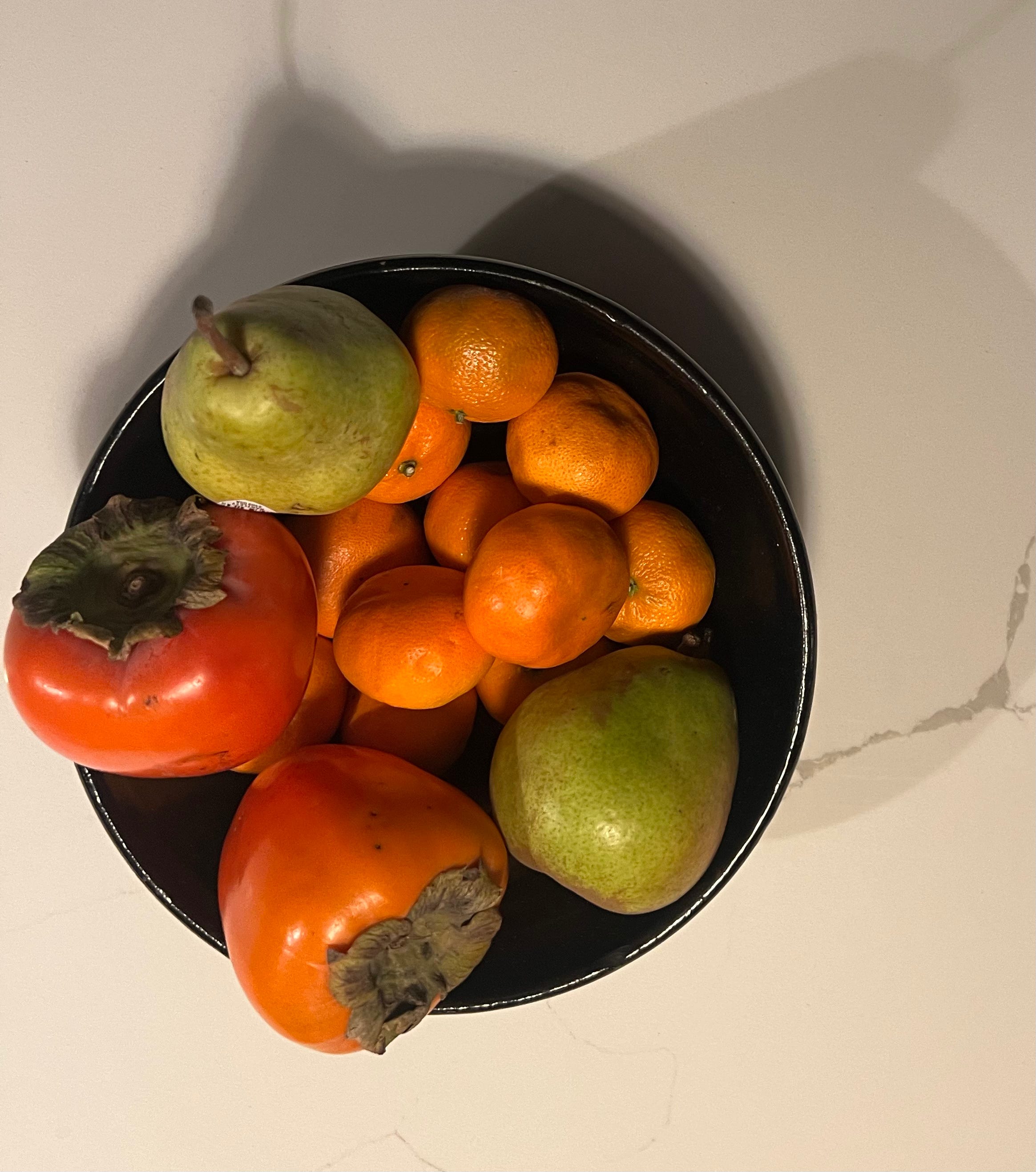
P.S. a bowl of seasonal fruit I am finding delightful